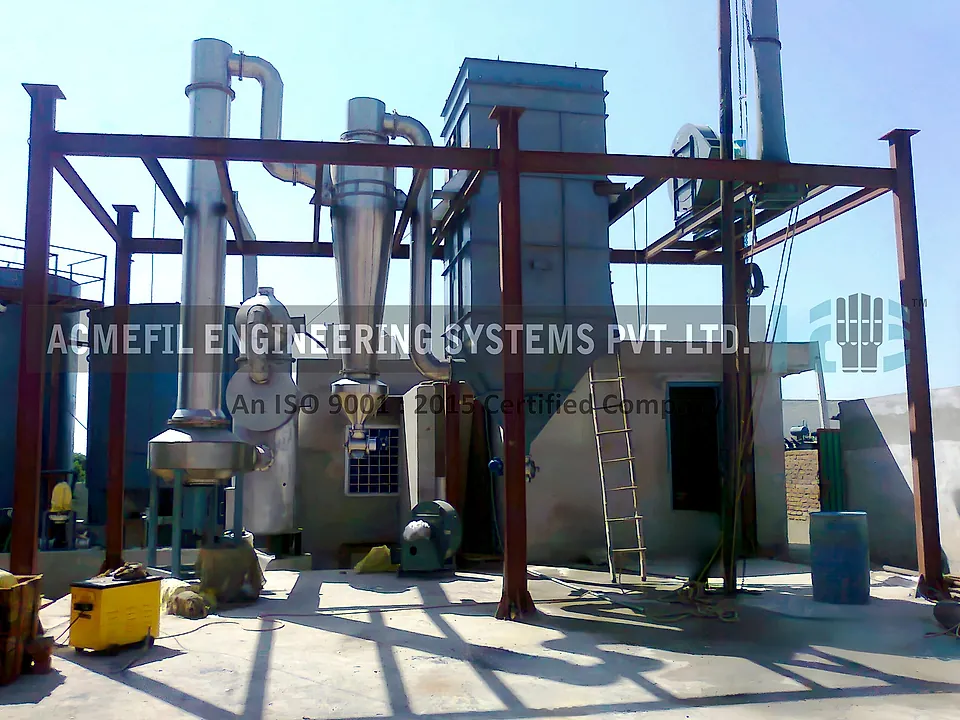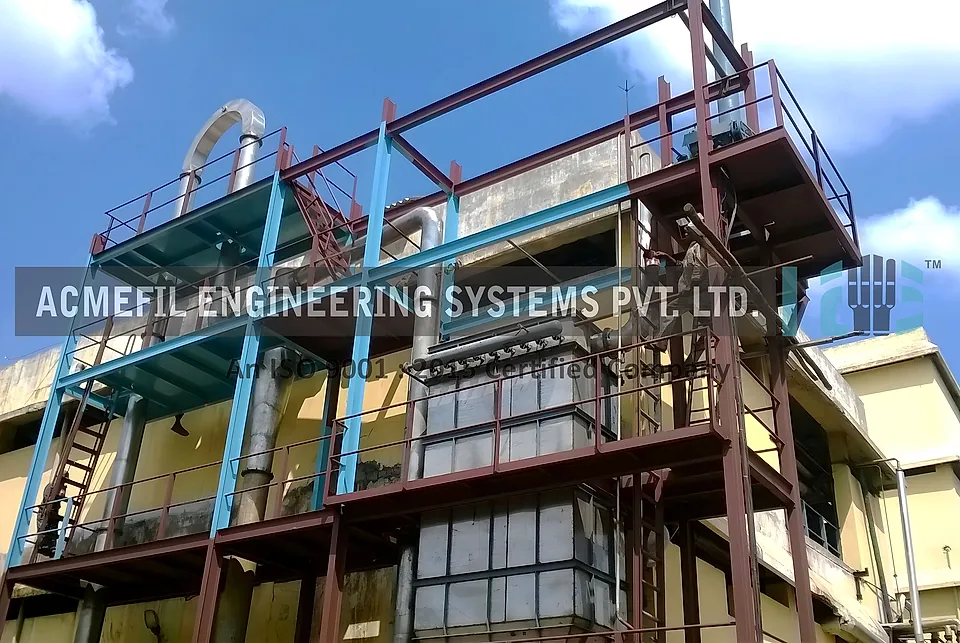
Flash dryers
Loose, crumbly wet solids are fed into a fast stream of hot air, carried up a drying duct and dried in seconds – continuous, simple and compact.
- Seconds of drying
- Continuous
- Simple, compact layout
Flash or spin flash dryer – or another dryer altogether? Three questions give you a starting point.
Dryer finder
Three quick questions for a starting point. If a flash dryer is the wrong tool for your feed, the finder says so.
Typical products:
General guidance only – the final choice depends on moisture, stickiness, heat sensitivity and capacity. We confirm it on your product data or in a pilot trial.
How they work
Wet product in, dry powder out. Pick a view and watch the particles ride the hot air.
Acmefil
Typical products: Starch, minerals, pigments, inorganic salts, fillers, chemical powders
Acmefil
Typical products: Pigment and dye cake, agrochemicals, chemical cake
Acmefil
Typical products: Chemical powders, minerals, pigments, starch, fillers
Two flash dryers
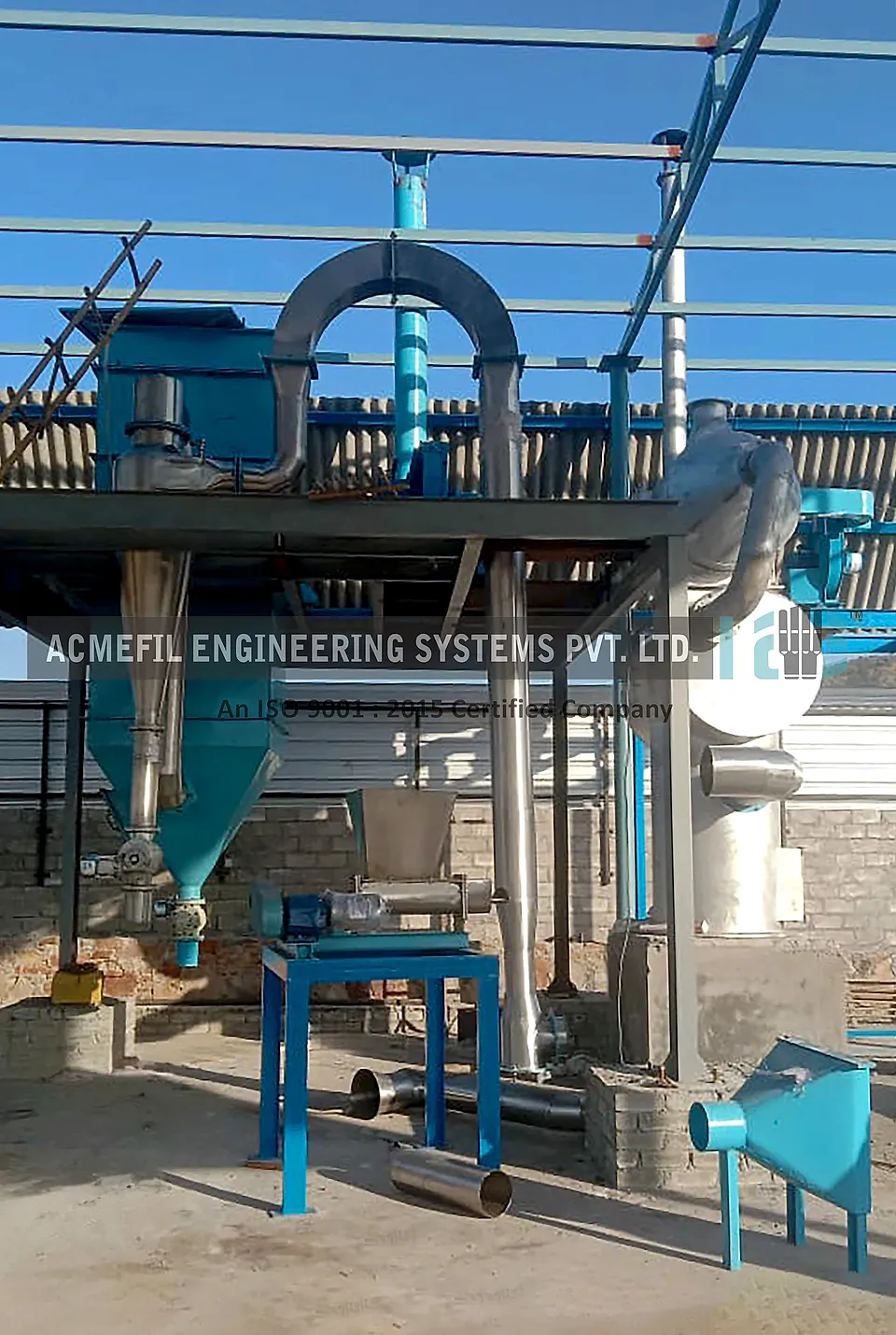
A flash dryer for loose wet solids, a spin flash dryer for wet cake and paste – both built by Acmefil.
Loose, crumbly wet solids are fed into a fast stream of hot air, carried up a drying duct and dried in seconds – continuous, simple and compact.
Wet cake and paste are broken up by a rotor inside a swirling hot-air vortex and leave as dry powder – for feeds a plain flash dryer cannot disperse.
Compare
How the feed, drying time, product form and footprint differ – including when a fluid bed, spray or paddle dryer is the better choice.
| Flash dryer | Spin flash dryer | Fluid bed dryer | Spray dryer | Paddle dryer | |
|---|---|---|---|---|---|
| Feed | Loose, crumbly wet solids – powders, granules, pastes that disperse | Wet cake, filter cake and paste that are not free-flowing | Free-flowing granules, crystals and pellets | Pumpable liquids, slurries, solutions | Sludge, pastes, wet cake, slurries |
| How it dries | Particles carried in a stream of hot air through a drying duct | A rotor breaks the cake up in a swirling hot-air vortex | Hot air lifts the bed; vibration can move it along | Droplets atomized into a hot-air chamber | Indirect heat through hollow paddles and jacket |
| Drying time | Seconds | Seconds | Minutes | Seconds | Minutes to hours |
| Product | Dry powder, as fed | Fine, de-agglomerated powder | Dry, intact granules and crystals | Fine, free-flowing, often spherical powder | Granules or powder |
| Footprint | Tall duct, simple layout | Compact, vertical | Long, low body | Large chamber and tall structure | Long horizontal body |
| Main limit | Not for sticky or lumpy feed that will not disperse | Feed must be screw-conveyable | Feed must fluidize; fines need dust collection | Feed must be pumpable | Larger size per kg of water than flash drying |
| Typical products | Starch, minerals, pigments, inorganic salts, fillers, chemical powders | Pigment and dye cake, agrochemicals, chemical cake | Salts, crystals, pharma and food granules, fertilizers | Dyes, detergents, food and dairy powders, ceramics, pharma, herbal extracts | ETP and STP sludge, pigments, gypsum, salts, starch |
| Typical heating | Hot air – gas, oil, steam or electric heaters | Hot air – direct or indirect fired | Hot air – steam, electric, thermic fluid or gas-fired | Hot air – gas, oil, steam or electric heaters | Steam, thermic fluid or hot oil (indirect) |
Typical behaviour from industry practice; your product sets the real answer – use the dryer finder or send us your product data.
Selection guide
Know these before you ask for a quote – they are what our process engineers ask first.
Loose powder, wet cake or paste? It decides between a flash and a spin flash dryer – or a different dryer altogether.
The feed moisture and the final moisture you need set how much water has to be evaporated per hour – the real size of the dryer.
Sticky or lumpy feed will not disperse in a plain duct. A rotor, a disintegrating feeder or back-mixing is needed.
Flash drying keeps the product in hot air for seconds only, and the air temperature is set to protect colour and activity.
Particle size, bulk density and the final powder you need decide the air velocity and the collection system.
Gas, oil, steam or electric hot air – each changes the heater, the layout and the running cost.
Fine dust, solvent vapour or explosion risk shape the cyclone, bag filter and construction.
Dryers are sized by water evaporated in kg/hr – not by the weight of the product alone.
Quote checklist
The more you share, the sharper the recommendation. A lab report or a sample photo helps most.
Free proposal
Tell us the product, feed form, moisture and capacity – we recommend the dryer, a budget quote and a pilot-trial option.
Secure form
Prefer to talk? +91 98250 13851 · WhatsApp